
Invisalign
Invisalign straightens crooked, crowded or gapped teeth, and can correct many bite problems, using a series of clear, removable plastic aligners with no brackets or wires. Each aligner is custom-made from a digital scan of your teeth and shaped to move them a small step closer to a planned final position. Invisalign is Align Technology's brand of clear aligner, and it is the system we use for clear aligner treatment; other clear aligner systems work on the same principle. You wear your aligners 22 hours a day, and once your teeth reach their planned positions, a retainer holds the result.
Who you'll see
-

Soo Jin Kim, DDS
NYU-trained family and cosmetic dentist with a hospital residency at Mount Sinai
Provides Invisalign and other orthodontic treatment.
- Dental degree
- DDS, New York University, Omicron Kappa Upsilon honor society
- Residency
- Icahn School of Medicine at Mount Sinai
When adults tell Dr. Kim they wish they had straightened their teeth when they were younger, she tells them it is not too late.
Patient reviews
-
“Dr. Kim, Jenny & the entire staff were a breath of fresh air.”
– Stephen B
-
“I did not have to wait at all to be seen and everyone in the office was extremely friendly and explained everything very well.”
– Yoanny B
-
“The professional staff starts with Dr. Kim.”
– Robert
-
“From the first phone call, politeness and quickness to get an appointment, I felt good vibes from the get go.”
– Colleen F
Dr. Kim on clear aligner therapy
Overview
Invisalign is a clear aligner system: a custom series of thin, transparent plastic trays, each shaped a little closer to the planned final position of the teeth. Worn in sequence, the trays move the teeth gradually, one small step per aligner. Because they are hard to see and come out for eating and brushing, aligners are an option for teens and adults who want to straighten their teeth without fixed braces.
Treatment is planned before the first aligner is made. A digital scan of the teeth becomes a 3D model, and planning software maps how each tooth will move, stage by stage. Small tooth-colored bumps called attachments are often bonded to some teeth so the aligners can grip them, and elastics may be added to help correct the bite. Progress is checked at periodic visits while the aligners are worn.
Aligners are most often used for mild to moderate crowding, spacing, and bite problems. The FDA notes that more complex conditions may need braces or other treatments, and large differences in the size or position of the jaws can call for orthodontics combined with jaw surgery.
When the teeth reach their planned positions, a retainer holds them there. Teeth tend to drift back toward their old positions without one, so retainer wear continues long after the last aligner is finished.
When It's Recommended
- Crowded or overlapping teeth
- Gaps or spacing between teeth
- Crooked or rotated teeth
- Mild to moderate bite problems, including some overbites, underbites, crossbites, and open bites
- Teeth that have shifted after earlier orthodontic treatment (orthodontic relapse)
- Teens and adults who prefer a removable, less visible appliance to fixed braces
What are the risks of Invisalign?
When to avoid
- Active, untreated gum disease (periodontitis) or tooth decay, until it is brought under control
- Inability to wear removable aligners for at least 20 hours a day, which tooth movement depends on
- Known allergy to the aligner plastic
Possible risks
- Pressure, soreness, or tenderness of the teeth for a few days after each new aligner
- Temporary speech changes, such as a slight lisp, while adjusting to the aligners
- Irritation, scrapes, or small cuts of the gums, tongue, or cheeks from aligner edges or attachments
- Irritation or allergic reaction to the aligner material
- Tooth decay or gum inflammation when food or sugary drinks are trapped under the aligners
- Loosening or dislodging of existing crowns, fillings, implant restorations, or bonded attachments
- Root resorption (shortening of the tooth roots), a recognized risk of orthodontic tooth movement
- Jaw discomfort or a temporary change in how the teeth meet as the bite shifts
- Tooth movement that falls behind the plan when aligners are worn less than directed, which can lengthen treatment
- Lost or damaged aligners
- Relapse, with teeth drifting back toward their old positions if retainers are not worn after treatment
Who needs extra care
- Complex problems, such as large front-to-back or vertical bite discrepancies, closing spaces left by extractions, or widening the dental arches, often call for attachments, elastics, refinement aligners, or a combination with fixed braces or jaw surgery
- Existing crowns, bridges, large fillings, and dental implants are assessed before treatment, because implants do not move with orthodontic force and the plan is built around them, and crowns and fillings can loosen during tooth movement
- A history of gum disease calls for stable gum health before tooth movement begins and additional periodontal monitoring during treatment
What to Expect During Treatment
- At your consultation, we examine your teeth, gums and bite, sometimes taking digital X-rays and photographs. We offer both aligners and traditional braces and discuss which suits you
- We scan your teeth with a small intraoral scanner and use that digital impression to build the 3D model for planning each stage of tooth movement
- Planning software shows the projected movement stage by stage, and with Invisalign you can usually preview the planned final position before treatment starts
- Once you approve the plan, your full series of aligners is made from it
- At the fitting visit, we may bond small tooth-colored attachments to some teeth, and you receive your first aligners with instructions for wearing and cleaning them
- At home you move to a new set of aligners every one to two weeks, taking them out only to eat, to drink anything other than plain water, and to brush and floss
- Every six to eight weeks you come in for a progress visit, where we check how the aligners fit and how your teeth are moving and give you your next sets of aligners
- If some teeth need further adjustment, we may take a new scan partway through or near the end to make refinement aligners
- When your teeth reach their planned positions, we polish off the attachments and fit you with a retainer to hold the result
How does Invisalign work?
Each aligner is shaped slightly ahead of the current position of the teeth. Snapped into place, the plastic presses on specific teeth with light, continuous force. That pressure acts on the ligament and bone around each tooth root, and as the bone remodels, the tooth moves a small amount with each aligner in the series.
- The full correction is planned before treatment begins. A digital scan builds a 3D model of the teeth, and planning software (ClinCheck, in the Invisalign system) breaks the total movement into stages, one per aligner. The aligners are then manufactured from that plan in Align Technology's SmartTrack plastic.
- Attachments, small tooth-colored composite shapes bonded to selected teeth, give the aligner surfaces to push against. They help with movements a smooth plastic shell grips poorly, such as rotating rounded teeth, raising or lowering a tooth, and moving a tooth bodily rather than tipping it. Elastics, and sometimes a small amount of enamel polishing between teeth (interproximal reduction) to make room, can be added to the plan.
- Aligners move teeth most predictably when tipping, leveling, and rotating most teeth. Because some teeth may lag behind the plan, many cases include one or more sets of refinement aligners, made from a new scan, to finish the movement.
Recovery & Aftercare
- Pressure or soreness after switching to a new aligner usually eases within a few days
- A slight lisp, if it occurs, typically fades as the tongue adjusts to the aligners
- Normal daily activities continue throughout treatment; aligners come out for meals, drinks other than water, and cleaning, and go back in afterward
- After active treatment, the attachments are polished off and a retainer holds the teeth in their new positions
- Retainer wear continues long after the aligners are finished, because teeth tend to drift back toward their original positions without one
Alternative Treatments
- Traditional metal braces (brackets bonded to the teeth and joined by wires), often used for more complex tooth movements
- Ceramic braces with tooth-colored brackets
- Lingual braces bonded to the back surfaces of the teeth
- Other brands of prescription clear aligners, which work on the same principle
- Veneers or bonding to improve the look of mildly crooked teeth without moving them
- Orthodontic treatment combined with jaw surgery for bite problems caused by the size or position of the jaws
What the Research Says
- Clear aligners are prescription devices in the United States, and the FDA has not authorized aligners sold directly to consumers without a prescription and supervision[1]
- Align Technology's original aligner system received FDA 510(k) clearance in September 1998 as a sequential aligner device[2]
- A 2018 systematic review of 22 studies found consistent support for Invisalign as an alternative to conventional braces for mild to moderate malocclusions in patients whose jaws have finished growing and who do not need extractions[3]
- In a randomized trial of 41 adults, patients treated with aligners reported less discomfort than patients with fixed braces during the first week of treatment[5]
- A 2023 meta-analysis found better plaque, gum-inflammation, and gum-bleeding scores in patients treated with clear aligners than in patients treated with fixed appliances[6]
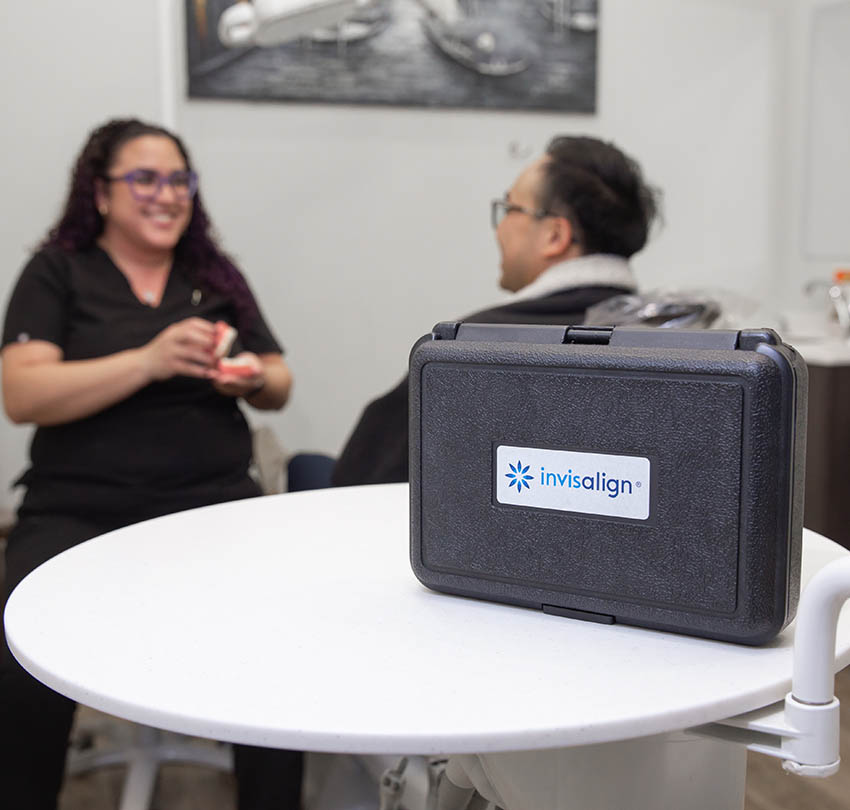
A patient on Invisalign at ConfiDental

Frequently Asked Questions
What is Invisalign?
Does Invisalign hurt?
Is Invisalign safe?
How long does Invisalign treatment take?
What happens during Invisalign treatment?
Who should not get Invisalign?
How is Invisalign different from braces?
Am I too old for Invisalign?
How much does Invisalign cost?
Sources & References
This article draws from 10 peer-reviewed sources.
- [1]U.S. Food and Drug Administration – Clear Dental Aligners
- [2]FDA 510(k) Premarket Notification K981095 – Align System (Align Technology)
- [3]Clinical effectiveness of Invisalign orthodontic treatment: a systematic review (Progress in Orthodontics, 2018)
- [4]Effectiveness of clear aligner therapy for orthodontic treatment: A systematic review (Orthodontics & Craniofacial Research, 2020)
- [5]Discomfort associated with Invisalign and traditional brackets: A randomized, prospective trial (Angle Orthodontist, 2017)
- [6]Periodontal health status, oral microbiome, white-spot lesions and oral health related to quality of life – clear aligners versus fixed appliances: A systematic review, meta-analysis and meta-regression (Korean Journal of Orthodontics, 2023)
- [7]MedlinePlus – Malocclusion of teeth
- [8]American Dental Association MouthHealthy – Braces
- [9]Cleveland Clinic – Clear Aligners
- [10]Invisalign (Align Technology) – How Invisalign Works