
Porcelain Veneers
If your front teeth are stained, chipped, worn, gapped or slightly crooked, porcelain veneers can change their color, shape and size. Each veneer is a thin ceramic shell made to fit one tooth, and we bond it to the tooth's front surface after removing less than a millimeter of enamel. With us, dental veneers can take as few as two visits, one to prepare your teeth and one to bond the finished set, and Dr. Kim sees you for both at ConfiDental in Carlstadt.
Who you'll see
-

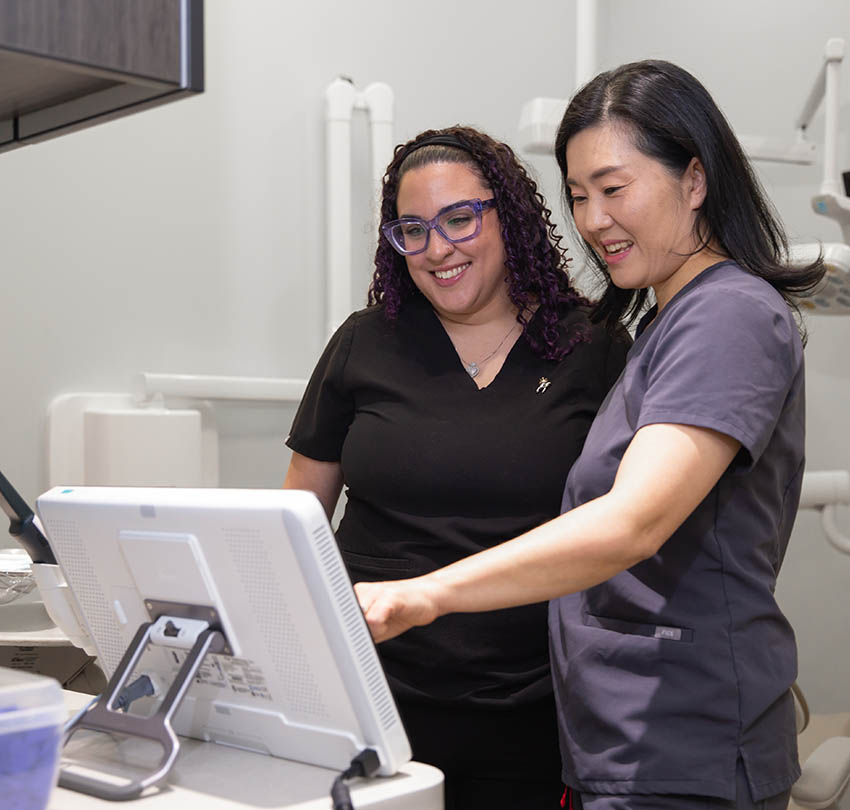
Soo Jin Kim, DDS
NYU-trained family and cosmetic dentist with a hospital residency at Mount Sinai
- Dental degree
- DDS, New York University, Omicron Kappa Upsilon honor society
- Residency
- Icahn School of Medicine at Mount Sinai
Dr. Kim's training includes a degree from New York City College of Technology in dental laboratory technology, the field that makes crowns and veneers.
Patient reviews
-
“Recently had porcelain veneers done top canine to canine and I couldn’t be happier with the results.”
– Stephen B
-
“Dr. Kim is so talented. I have trusted her with many procedures over the years.”
– Robert
-
“I love how thoroughly Dr. Kim answers all my questions.”
– Isabella F
-
“My consultation was like no other.”
– Colleen F
Dr. Kim on veneers
Overview
Porcelain veneers can make front teeth look brighter, more even and better proportioned by covering stains, chips, worn edges, small gaps and mild crookedness. Each veneer is a thin ceramic shell made in a dental lab to fit one tooth and bonded to its front surface. Because a veneer covers only the front of the tooth, it is less extensive than a crown, and veneers can be planned for a single tooth or across the whole smile.
Before the veneers are made, a thin layer of enamel, usually less than a millimeter, is removed from the front and sides of each tooth. This makes room for the ceramic so the finished tooth does not look or feel bulky, and the change is permanent. Preparation is kept within the enamel where possible, because veneers bond more reliably to enamel than to the dentin underneath. In the lab, veneers are built up in layers of feldspathic porcelain or pressed or milled from stronger glass-ceramics such as lithium disilicate, with the shade and translucency matched to the neighboring teeth.
Porcelain veneers have a long clinical record. One study that followed 318 glass-ceramic veneers for up to 20 years estimated survival at 93.5% after 10 years and about 83% after 20 years. On average, veneers last about 10 to 15 years with good care, and how long a set lasts depends on bite forces, the health of the teeth underneath and daily habits.
Two other options also cover the front of a tooth. Composite bonding is sculpted directly on the tooth from tooth-colored resin, usually with less enamel removed and in fewer visits, and it is easier to repair, but it resists staining and wear less well than porcelain. Minimal-prep and printed hybrid veneers are thinner and often need little or no enamel removal. Porcelain veneers involve more preparation and a lab step, and they offer greater resistance to staining and wear along with the longer clinical track record.
When It's Recommended
- Stained or discolored front teeth, including discoloration that does not improve with whitening, such as fluorosis or tetracycline staining
- Chipped or broken front teeth
- Front teeth with worn edges, or teeth worn by erosion
- Gaps between the front teeth (diastema)
- Front teeth that are mildly crooked, misshapen or small for the smile
- Enamel defects on the visible surfaces of the front teeth
- Older composite restorations on front teeth that are due for replacement
What are the risks of Porcelain Veneers?
When to avoid
- Untreated tooth decay or active gum disease, until treated
Possible risks
- Tooth sensitivity to heat and cold after enamel is removed
- Permanent loss of the enamel removed during preparation, which makes the treatment irreversible
- Chipping, cracking or fracture of the porcelain, the most frequently reported complication
- Debonding, in which a veneer loosens or comes off and may need to be re-bonded
- Tooth decay under or around the edges of a veneer
- Discoloration along the veneer margins over time
- Gum irritation at the veneer edges, for example from cement left at the margins
- Nerve problems in the tooth that need root canal treatment, which are uncommon
- Eventual need for repair or replacement of a veneer
Who needs extra care
- Heavy clenching or grinding of the teeth (bruxism), or a deep overbite, which raises the risk of veneer chipping or debonding and usually calls for a night guard or bite correction alongside veneers
- Little remaining enamel, as with extensive erosion or large existing fillings, which is assessed during planning because veneers bond less reliably to dentin than to enamel
- Teeth that have had root canal treatment, which showed a higher veneer failure risk in long-term follow-up and are assessed before veneers are planned
- Smoking, which is associated with more discoloration along the veneer margins
- Severe crowding or protruding teeth, which may call for orthodontic treatment before or alongside veneers
- Contact sports or other activities with a risk of mouth injury, where a mouthguard helps protect the veneers
- Grinding or clenching at night, where a night guard may be provided to help protect the veneers from chipping or fracture
What to Expect During Treatment
- A consultation and examination covering your smile goals, the health of your teeth and gums, and your bite
- We treat any decay or gum disease first, and if you want your teeth whitened, we finish that before the veneer shade is chosen
- We photograph your teeth and take digital scans on our intraoral scanner to plan the veneers, so there is no putty impression to bite into
- A preview of the planned tooth shapes may be prepared so you can see the proposed result
- If the preparation visit worries you, mention it when you book and we'll allow extra time for it; with oral conscious sedation, you swallow a pill shortly ahead of the appointment and need someone to drive you there and back
- Your teeth may be numbed with a local anesthetic, and we remove a thin layer of enamel from the front and sides of each tooth being treated
- Once the teeth are prepared, we scan them again and send the scans to our partner dental lab, where your veneers are made to fit
- You go home in temporary veneers and wear them while the lab makes your final set, which can take a few weeks
- At the next visit, we use try-in paste to position each veneer on your tooth and check its shape, fit and shade before bonding
- Your teeth are cleaned and etched, and each veneer is bonded with a resin cement that is hardened with a curing light
- Excess cement is removed, the edges are polished, and your bite is checked and adjusted
- A follow-up visit may be scheduled to check the gums and how the veneers feel
How do Porcelain Veneers work?
A porcelain veneer changes how a tooth looks by covering its visible front surface with a thin layer of ceramic, typically 0.3 to 1.0 mm thick. The ceramic is translucent, so light passes into it and scatters back much as it does through enamel, which helps a veneer look like a natural tooth.
- Preparation removes a controlled amount of enamel, commonly about 0.3 mm near the gumline increasing to about 0.7 mm toward the biting edge. That makes room for the ceramic so the finished tooth is not overbuilt, while leaving as much enamel as possible for the bond.
- The digital scan of the prepared teeth becomes a 3D model, and the dental lab makes each veneer to fit its tooth on that model. Feldspathic porcelain is built up in layers, while leucite-reinforced and lithium disilicate glass-ceramics are pressed or milled, and the stronger glass-ceramics are chosen where more strength is needed.
- A veneer is held on by adhesion rather than by gripping the tooth. The inside of the veneer is etched with hydrofluoric acid and coated with a silane primer, the enamel is etched with phosphoric acid, and a resin cement joins the two and is hardened with a curing light. Bonded to enamel, the thin ceramic shell and the tooth behave as a single strong unit.
Recovery & Aftercare
- Normal activities can generally resume the same day, with eating and drinking once any numbness has worn off
- Teeth may feel more sensitive to heat and cold after treatment
- It can take a few days to get used to how the veneers feel, and a bite that does not feel right after placement can be adjusted
- Brushing twice a day with a soft-bristled brush and a non-abrasive fluoride toothpaste, and cleaning between the teeth daily, help protect against decay under or around the veneers
- Avoiding nail biting and biting directly into hard objects or very hard foods lowers the risk of chipping
- A mouthguard during contact sports, and a night guard for people who grind their teeth, help protect the veneers
- Porcelain resists staining, and limiting coffee, tea and red wine is still commonly advised
- Regular checkups and cleanings allow the veneers, their edges and the surrounding gums to be checked over time
- A veneer that chips, cracks or comes loose can often be re-bonded, repaired or replaced
Alternative Treatments
- Composite bonding or composite veneers, sculpted directly on the teeth with less enamel removal and fewer visits, though less resistant to staining and wear
- Minimal-prep, no-prep or 3D-printed hybrid ceramic veneers, which are thinner and often placed with little or no enamel removal
- Teeth whitening for discoloration on teeth that are otherwise well shaped
- Orthodontic treatment, such as clear aligners, for crowding, rotation or gaps
- Crowns for teeth with large fillings or significant loss of tooth structure
What the Research Says
- A porcelain veneer is a thin, custom-made ceramic shell that covers the front surface of a tooth, whereas a crown covers the whole tooth[1]
- Conventional veneers typically range from 0.3 to 1.0 mm thick, compared with 0.2 to 0.5 mm for minimally invasive veneers[4]
- Bonding to enamel is more efficient and reliable than bonding to dentin, so veneer preparations aim to preserve as much enamel as possible[3]
- A 2025 meta-analysis of 29 clinical studies reported pooled survival of about 94% to 97% for feldspathic and glass-ceramic laminate veneers at 10.4 years[5]
- Placing porcelain veneers is not reversible, because enamel is removed from the front and sides of each tooth[1]
Frequently Asked Questions
What are porcelain veneers?
Do porcelain veneers hurt?
Are porcelain veneers safe?
How many visits do porcelain veneers take?
What happens during porcelain veneer treatment?
Who should not get porcelain veneers?
How long do porcelain veneers last?
Are 3D-printed veneers an alternative to porcelain veneers?
Can dental veneers be combined with whitening or bonding?
What happens at a veneers consultation?
Sources & References
This article draws from 10 peer-reviewed sources.
- [1]American Dental Association MouthHealthy – Veneers
- [2]Cleveland Clinic – Dental Veneers
- [3]Risk Factors with Porcelain Laminate Veneers Experienced during Cementation: A Review – Materials (2023), PMC
- [4]Conventional Versus Minimally Invasive Veneers: A Systematic Review – Cureus (2023), PMC
- [5]Survival and Complication Rates of Feldspathic, Leucite-Reinforced, Lithium Disilicate and Zirconia Ceramic Laminate Veneers: A Systematic Review and Meta-Analysis – J Esthet Restor Dent (2025), PMC
- [6]Clinical Performance of Porcelain Laminate Veneers for up to 20 Years – Int J Prosthodont (2012), PubMed
- [7]Long-Term Survival and Complication Rates of Porcelain Laminate Veneers in Clinical Studies: A Systematic Review – J Clin Med (2021), PMC
- [8]Main Clinical Outcomes of Feldspathic Porcelain and Glass-Ceramic Laminate Veneers: A Systematic Review and Meta-Analysis – PubMed
- [9]Survival Rates for Porcelain Laminate Veneers: A Systematic Review – Eur J Dent (2021), PMC
- [10]Partial Ceramic Veneers as a Conservative Restorative Strategy: A Narrative Review with Case Report – Dent J (2026), PMC