SmileSculpt Veneers
SmileSculpt veneers cover chipped, stained, worn, gapped or uneven front teeth with thin custom shells that are 3D printed and bonded over the natural teeth, often with little or no enamel removed. Each veneer is designed from a digital scan, printed in a ceramic-filled resin marketed as a porcelain-resin hybrid, and bonded, sculpted and polished in place. SmileSculpt starts with a consultation and digital scan. At the next visit, you see a mock-up of your design over your teeth, and we place the veneers over one or two more visits.
Who you'll see
-

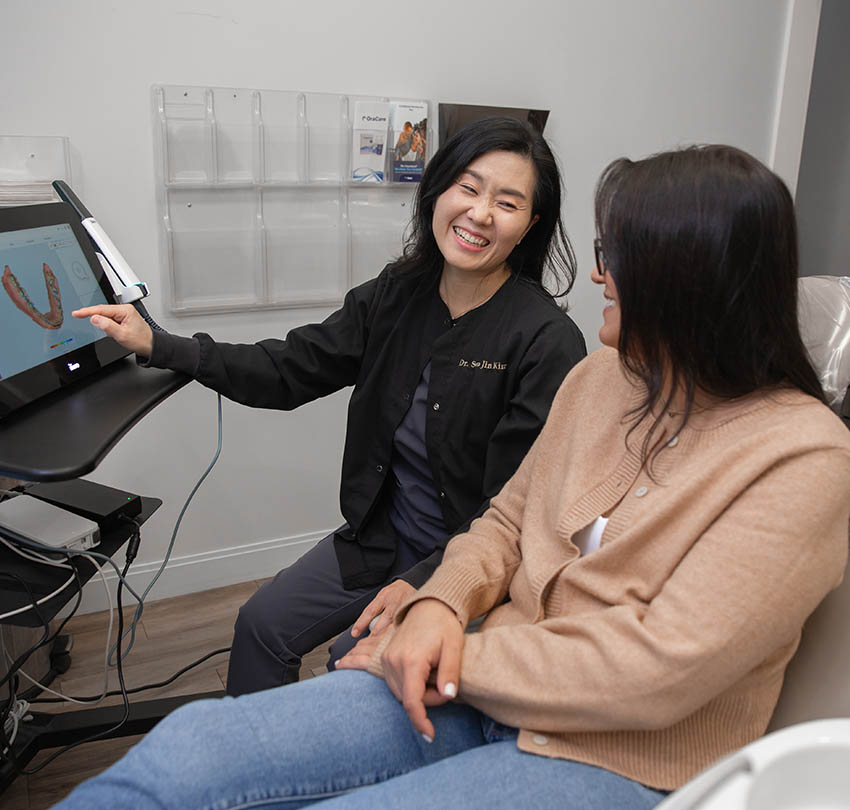
Soo Jin Kim, DDS
NYU-trained family and cosmetic dentist with a hospital residency at Mount Sinai
- Dental degree
- DDS, New York University, Omicron Kappa Upsilon honor society
- Residency
- Icahn School of Medicine at Mount Sinai
Dr. Kim looks after cosmetic care at our Carlstadt office, plans and places SmileSculpt veneers, and walks you through each stage before anything is bonded. She also holds a degree in dental laboratory technology from New York City College of Technology.
Patient reviews
-
“If I could leave 20 stars I would.”
– Colleen F
-
“I did not have to wait at all to be seen and everyone in the office was extremely friendly and explained everything very well.”
– Yoanny B
-
“Dr. Kim, Jenny & the entire staff were a breath of fresh air.”
– Stephen B
-
“The professional staff starts with Dr. Kim.”
– Robert
Overview
SmileSculpt is a cosmetic veneer method developed by Dr. Brian Harris, a Phoenix dentist, and taught to dental practices through a certification course. The name covers a whole workflow rather than a single product: a digital scan, a digital smile design, veneers 3D printed in a hybrid ceramic resin, and a sequence for bonding, sculpting and polishing them on the teeth. Printing can happen in the office, which allows same-day placement, or at a dental lab.
The material is marketed as a porcelain-resin hybrid. In dental-materials terms it is a resin-based composite: a light-cured resin matrix loaded with ceramic filler particles, printed layer by layer rather than fired like porcelain. One resin used for printed veneers is formulated with more than 60% ceramic particles by weight. The course materials name no single resin or printer, so the material, its filler content and its finishing can differ from one practice to another.
Compared with porcelain veneers, printed hybrid veneers are usually thinner, are often placed with little or no enamel reduction, can be adjusted and polished directly on the teeth, and can be repaired with bonding or reprinted from the saved design. Porcelain veneers are typically made in a lab after a small amount of enamel is removed from the front and sides of each tooth, and they have the longer clinical track record along with greater resistance to staining and wear. Printed resins hold their color less well than milled resins and ceramics in laboratory testing, so diet, smoking and routine polishing matter more to how the veneers look over the years.
SmileSculpt is generally considered for healthy front teeth that are chipped, worn, stained, gapped or slightly misshapen. Decay and gum disease are treated before veneers are planned, while heavy clenching or grinding, a deep overbite, or severe crowding can make thin bonded veneers a poorer fit or call for other treatment first.
When It's Recommended
- Chipped or broken front teeth
- Front teeth with worn or shortened edges
- Stained or discolored teeth
- Small gaps between the front teeth
- Teeth that are slightly crooked, misshapen or uneven in size
- Smile makeovers planned with little or no enamel removal
What are the risks of SmileSculpt Veneers?
When to avoid
- Untreated tooth decay or active gum disease, until treated
Possible risks
- Gradual staining or loss of surface gloss, since printed resins hold color less well than milled resins and ceramics
- Surface wear over time, as resin-based veneers resist wear less than porcelain
- Chipping or fracture, particularly at thin edges or when biting hard foods or objects
- Loosening or debonding of a veneer, which may require re-bonding
- Surface roughness, color mismatch or discoloration at the margins, the complications most often reported for composite veneers
- Excess contour at the gumline on no-prep veneers, which can make cleaning harder and may affect gum health
- Tooth decay under or around the edges of a veneer
- Eventual need for polishing, repair or replacement
Who needs extra care
- Heavy clenching or grinding of the teeth, or a deep overbite, which raises the risk of chipping or debonding and usually calls for a night guard or bite correction alongside veneers
- Severe crowding, which may call for orthodontic treatment before or alongside veneers
- Contact sports or other activities with a risk of mouth injury, where a mouthguard helps protect the veneers
What to Expect During Treatment
- At the consultation, we go over what you'd like to change about your smile and examine your teeth, gums and bite
- Any decay or gum disease is treated before veneers are planned
- We take a digital scan with our Lumina or Medit intraoral scanner to plan your SmileSculpt veneers; photographs may also help guide the design
- Your new smile is designed digitally from the scan, and at a separate visit a mock-up of that design is tried in over your teeth to preview the look; a printed sample may also be tried in to check the shade before the final veneers are made
- If the plan calls for it, a small amount of enamel is smoothed in specific spots; some plans involve no enamel removal at all
- The veneers are 3D printed, either in the office or by a dental lab, then cleaned, post-cured and polished
- At the appointment to place your veneers, we check each one's fit and shade on your teeth before bonding it
- Your teeth are cleaned and conditioned, and each veneer is bonded in place with a light-cured resin cement
- The edges, length and contour are sculpted and polished while you are in the chair, and your bite is checked
- A follow-up visit may be scheduled to check the gums and refine the polish
How do SmileSculpt Veneers work?
An intraoral scanner records the teeth as a 3D model in place of putty impressions, and that model is the base for a digital design of each veneer's length, width and contour.
- The design is printed in a ceramic-filled resin by vat photopolymerization, which hardens liquid resin layer by layer with light. The printed veneers are then cleaned, post-cured and finished, steps that strongly affect the final material's strength and color.
- The inner surface of each veneer is roughened and primed, the enamel is conditioned, and a light-cured resin cement bonds the shell to the tooth, so a very thin veneer is held in place by adhesion.
- Once bonded, the edges and surfaces are sculpted and polished on the teeth, so length, shape and contour can be refined before the appointment ends.
- When little or no enamel is removed, most of the natural tooth structure stays in place underneath the veneer.
Recovery & Aftercare
- Normal eating and daily activities can generally resume after the appointment
- It may take a few days to get used to how the veneers feel, and a bite that does not feel right after placement can be adjusted
- Brushing twice a day with fluoride toothpaste and cleaning between the teeth daily help protect against decay under or around the veneers
- Limiting coffee, tea, red wine and tobacco helps slow staining of resin veneers
- Avoiding nail biting and chewing on hard objects such as ice or pens lowers the risk of chipping
- Periodic professional polishing keeps the surface smooth, which supports color stability
- A chipped or worn veneer can often be repaired with bonding or reprinted from the saved design
Alternative Treatments
- Porcelain veneers, lab-made ceramic shells with greater stain and wear resistance that usually involve some enamel reduction
- Composite bonding or direct composite veneers, sculpted by hand on the teeth
- Teeth whitening for discoloration on teeth that are otherwise well shaped
- Orthodontic treatment, such as clear aligners, for crowding, rotation or gaps
- Crowns for teeth with large fillings or significant structural loss
What the Research Says
- SmileSculpt is a branded workflow for designing, 3D printing, bonding and hand-finishing veneers made from a hybrid ceramic resin, with printing done in the office or by a dental lab[1]
- Minimally invasive and no-prep veneers are typically 0.2 to 0.5 mm thick and need minimal or no enamel removal, compared with 0.3 to 1.0 mm for conventional veneers[7]
- A 2023 meta-analysis of resin composite veneers, the material family printed hybrid veneers belong to, reported pooled survival of about 88% in trials with mean follow-up of 24 to 97 months[8]
- Printed resin restorations can be repaired by applying a primer and bonding agent, much as direct composite restorations are[4]
- Because each veneer is printed from a saved digital design, a fractured veneer can be reprinted from the original file[2]
Frequently Asked Questions
What are SmileSculpt veneers?
Do SmileSculpt veneers hurt?
Are SmileSculpt veneers safe?
How many visits do SmileSculpt veneers take?
What happens during SmileSculpt treatment?
How do SmileSculpt veneers compare with porcelain veneers?
Who should not get SmileSculpt veneers?
Can my SmileSculpt visits be in Korean?
Sources & References
This article draws from 10 peer-reviewed sources.
- [1]SmileSculpt Course – Dental Practice Mastery (developer's certification course)
- [2]In-Office 3D Veneer Printing for Aesthetic Smile Enhancement – Dentistry Today (Harris and Kurtzman, 2025)
- [3]American Dental Association MouthHealthy – Veneers
- [4]Narrative Review of 3D-Printed Temporary and Permanent Dental Resin Restorations – Polymer Testing (2025)
- [5]Mechanical Properties of 3D Printed vs. Subtractively Manufactured Composite Resins for Permanent Restorations: A Systematic Review – PMC
- [6]Enhancing Esthetics With Digital Dentistry: A 2-Year Follow-Up of 3D-Printed Restorations – PMC
- [7]Conventional Versus Minimally Invasive Veneers: A Systematic Review – PMC
- [8]Survival and Complication Rates of Resin Composite Laminate Veneers: A Systematic Review and Meta-Analysis – PubMed
- [9]Main Clinical Outcomes of Feldspathic Porcelain and Glass-Ceramic Laminate Veneers: A Systematic Review and Meta-Analysis – PubMed
- [10]Partial-Prep Bonded Restorations in the Anterior Dentition: Long-Term Gingival Health and Predictability – PubMed