Dental Implants
Last updated: November 22, 2026 Reviewed by Soo Jin Kim, DDS
Dental implants can restore your chewing and the look of a full smile without reshaping neighboring teeth to hold the new ones. The implant itself is a small post, usually titanium or zirconia, that takes the place of the root in your jawbone and anchors the new tooth there. Over the next several months your bone bonds tightly to the post (osseointegration), and we then join the implant to your crown, bridge or denture with a connector called an abutment. We can use one implant for a single tooth, several to carry a bridge, or two or more to hold a full denture in place. You go through every step in one office, ConfiDental in Carlstadt, from the first consultation to the final crown, bridge or denture, and our board-certified periodontist places the implants.
Who You'll See
-
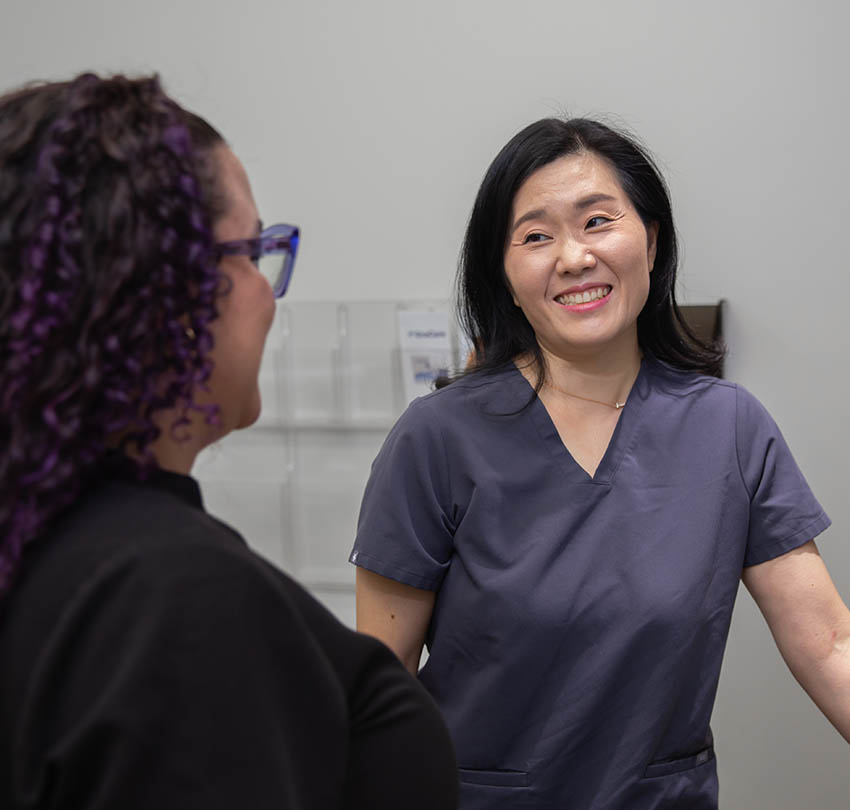
Soo Jin Kim, DDS
Family and cosmetic dentist
Designs and fits the teeth the implants hold.
- Dental degree
- DDS, New York University, Omicron Kappa Upsilon honor society
- Residency
- Icahn School of Medicine at Mount Sinai
-

Sung Min Lee, DDS
Periodontist
Places the implants.
- Board certified
- American Board of Periodontology, 2023
- Specialty training
- Periodontics residency, Columbia University
For one missing tooth, Dr. Kim recommends an implant because it can be restored on its own, without touching the teeth in front of it or behind it, and the implant keeps the neighboring teeth from drifting into the gap. When several teeth are missing, implants restore them to work and feel much like natural teeth.
Patient reviews
-
“Not only did they exemplify professionalism but were also extremely friendly and thorough during the entire process.”
– Stephen B
-
“From the first phone call, politeness and quickness to get an appointment, I felt good vibes from the get go.”
– Colleen F
-
“Dr. Kim and the entire team is amazing.”
– Massiel Melo S
-
“Thank you to the entire staff for so many perfect visits.”
– Robert
Dr. Kim on dental implants
Overview
With a dental implant, we replace the root of a missing tooth as well as the part you see, which can help preserve the jawbone around it. When a tooth is missing, the gap affects chewing and appearance, and the bone that once held its root begins to change (remodel). Major changes to that ridge of bone take place during the first year after a tooth is extracted. Of the modern implants that were followed, an estimated 93% to 96% were still in place at 10 years.
Your implant comes in three parts. The first is the threaded post, the implant itself, which sits in your jawbone. The abutment connects to the post and comes up through your gum. Last comes your crown, bridge or denture, which attaches to the abutment and is the part you see in your mouth. If the bone is too thin, or the sinus in your upper jaw sits too low, we may first rebuild the site with a bone graft or a sinus lift, each a separate procedure.
When a jaw has no teeth left, we use the same approach to hold a denture. Two or more implants carry attachments the denture clips onto, so it stays put and doesn't sit on your gums alone, and it is still removable for cleaning. For a toothless lower jaw, consensus statements describe a denture held by two implants as the first-choice treatment, and people with one have reported higher satisfaction and quality of life than with a conventional denture. We plan a fixed full-arch bridge, often called All-on-X, separately, as its own treatment.
What to Expect During Treatment
- The consultation starts with your dental and medical history and medications; we examine the gums and remaining teeth and talk about the replacement you want
- Imaging measures the bone and locates the nerve and sinus. When your case needs a cone-beam CT scan, we can take it in our office during the consultation. The planned position of your new tooth guides where we place the implant
- We treat any gum disease first, and if the site needs more bone, a bone graft or, in the upper back jaw, a sinus lift is completed beforehand by our periodontist
- On the day of surgery, local anesthetic numbs the area
- Our periodontist makes a small opening in the gum, prepares the bone with a sequence of drills, and places the implant; when a failing tooth comes out at the same visit, she can set an immediate implant in its socket
- The gum is closed over the implant or around a healing cap, sometimes with a few stitches
- The implant integrates with the bone over the following months, and a temporary tooth or your existing denture may be worn during this time
- In two-stage treatment, a short second step uncovers the implant and attaches a healing abutment
- Once the implant has bonded with the bone, we use our intraoral scanner to take a digital scan of the implant site and the bite. That digital impression is used to make the final crown, bridge, or denture
- We attach the abutment and the final crown, bridge, or denture, check the bite, and show you how to clean around the implant
- Follow-up and maintenance visits check the implant, the gum around it, and the bone level over time
Risks
When to avoid
- Acute illness, or an active infection or other disease in the jawbone or gum at the planned implant site
- Uncontrolled metabolic disease, such as poorly controlled diabetes
- Active, untreated periodontal (gum) disease
- Jaw growth that is not yet complete, as in children and younger adolescents
Possible risks
- Pain, swelling, and bruising in the first days after surgery
- Infection at the implant site
- Bleeding during or after surgery
- Opening of the gum incision during healing
- Nerve injury in the lower jaw, causing numbness, tingling, or altered sensation of the lip, chin, or gums that may be temporary or persistent
- Sinus perforation (an opening made into the sinus) when an implant is placed in the upper back jaw
- Damage to neighboring teeth
- Failure of the implant to integrate with the bone, or loosening later, which may require its removal
- Peri-implant mucositis and peri-implantitis, inflammation around the implant that can progress to loss of the supporting bone
- Loosening or fracture of the abutment screw or the restoration
- Difficulty cleaning the gum around the implant
- Fracture of the jawbone, which is rare
Who needs extra care
- Too little bone height or width at the site may call for a bone graft or sinus lift before the implant is placed, or for a shorter or narrower implant
- Smoking is reviewed during planning, because people who smoke have a higher rate of implant failure, more infections after surgery, and more bone loss around the implant
- Diabetes and other chronic conditions are reviewed before surgery; how well a condition is controlled generally matters more than the diagnosis itself
- Bisphosphonate medication (medicine that slows bone loss), chemotherapy, or radiation therapy to the head and neck is linked to a higher risk of complications and is assessed before an implant is planned
- Teeth grinding or clenching (bruxism) adds load to implants and their restorations and is taken into account in the restoration design, sometimes with a protective night guard
- Blood-thinning medication and bleeding disorders are reviewed before surgery
- A history of severe periodontitis (gum disease) is linked to a higher risk of peri-implantitis (inflammation around an implant), which makes regular professional maintenance after treatment especially important
When It's Recommended
- A single tooth you've lost to an injury, decay or gum disease
- Several missing teeth that implant-supported crowns or a bridge could replace
- A gap at the end of your row of teeth, with no tooth behind it to hold a bridge
- A failing tooth you're planning to have taken out (extraction) and replaced
- All your teeth missing in one or both jaws, replaced with an implant-supported denture
- A conventional denture that's loose, shifts around, or is hard to keep in place
- Wanting to keep the healthy teeth beside a gap from being reshaped for a conventional bridge
How It Works
Your implant takes the place of the tooth's root. Your body doesn't react against titanium (it is bioinert), so your bone grows right against the implant surface, and the two meet in direct, rigid contact with no layer of soft tissue between them. That bond, called osseointegration, is what lets the implant take your chewing forces and hold up a new tooth.
- We plan where your implant goes around the crown, bridge or denture it will hold. Imaging, often a cone-beam CT scan, shows us how tall, wide and dense your bone is, and where nearby structures sit, such as the nerve canal in your lower jaw and the sinus in your upper jaw, so we can place the implant clear of them.
- To prepare the site, we use a series of drills, each a step larger than the last, under a stream of cool saline that keeps heat from harming the bone. Then we thread the implant in at the planned depth and angle.
- While your bone heals, the implant either stays covered by the gum (two-stage) or has a healing cap that comes through the gum (one-stage). The bond usually takes about 2 to 3 months to form in the lower jaw and 3 to 6 months in the upper jaw, and after that we attach the abutment and your final crown, bridge or denture. Some implants get a temporary tooth within a week of placement (immediate loading).
Recovery & Aftercare
- Mild pain, swelling, and bruising are common for the first few days, and usually respond to over-the-counter or prescribed pain relief
- Your gum goes through its first stage of healing in about a week
- You may be advised to eat soft foods, cold foods, and warm soup while the site heals
- Using tobacco can slow the healing of your implant site
- Your bone takes roughly 3 to 9 months to bond with the implant (integration), depending on the jaw, the bone, and whether you needed a graft, before we attach your final crown, bridge, or denture
- When the final crown, bridge or denture is on, you clean around the implant with the same brushing and flossing you give your natural teeth, and keeping your regular dental visits helps lower the risk of peri-implant disease (inflammation around the implant)
- If you notice swelling that worsens after the first few days, fever, pus, or an implant that feels loose, contact the dental office that placed it promptly